I haven’t seen Backrooms. I know it’s the highest-grossing film A24 have ever released. I know it was directed by Kane Parsons, who built the mythology on YouTube before he was old enough to vote. And I know it’s meant to be very good. I made it a very short way into the trailer before turning it off. I can’t do horror. Never could.
This is professionally awkward, because arguably one of the most interesting things to happen in quantum computing this year is a Backrooms game. Quantum Backrooms, released at the end of May by Moth, a quantum software company based in London, is a free browser game whose levels are generated on real quantum processors. Moth are calling it the world’s first quantum consumer product.
I’ve been circling this story for a while. Moth invited me to SXSW London festival in June, where their co-founder, Harry Kumar, delivered a lively and engaging presentation, and I spoke to him afterwards. They also sent me an early build of the game, and put up their chief science officer, James Wootton, for an interview a few days before launch. You can find both conversations below.
For the uninitiated, the Backrooms aesthetic began in 2019 as an anonymous forum post, a photograph of a yellowish office corridor and a warning that if you “noclip out of reality in the wrong areas” you end up there, in six hundred million square miles of empty rooms. From this grew an entire genre about places that are unsettling in ways you can’t quite name. And eventually a film, which I will not be seeing.
The test game arrived a few days before launch, and I did what I always do with anything haunted, which is to tackle it at lunchtime. There’s two modes, 2D arcade and 3D first person. The 2D arcade mode seemed safe enough for me. You’re looking down on a maze, trying to “reach the final floor before losing your sanity,” as Moth’s site puts it, and for the first few moves it’s reminiscent of Pac-Man. Then you double back the way you’d come, and the way you’d come wasn’t there. A wall instead. I knew what I’d signed up for, but anyone who didn’t would have two theories: they’re really bad at mazes, or the game is broken.
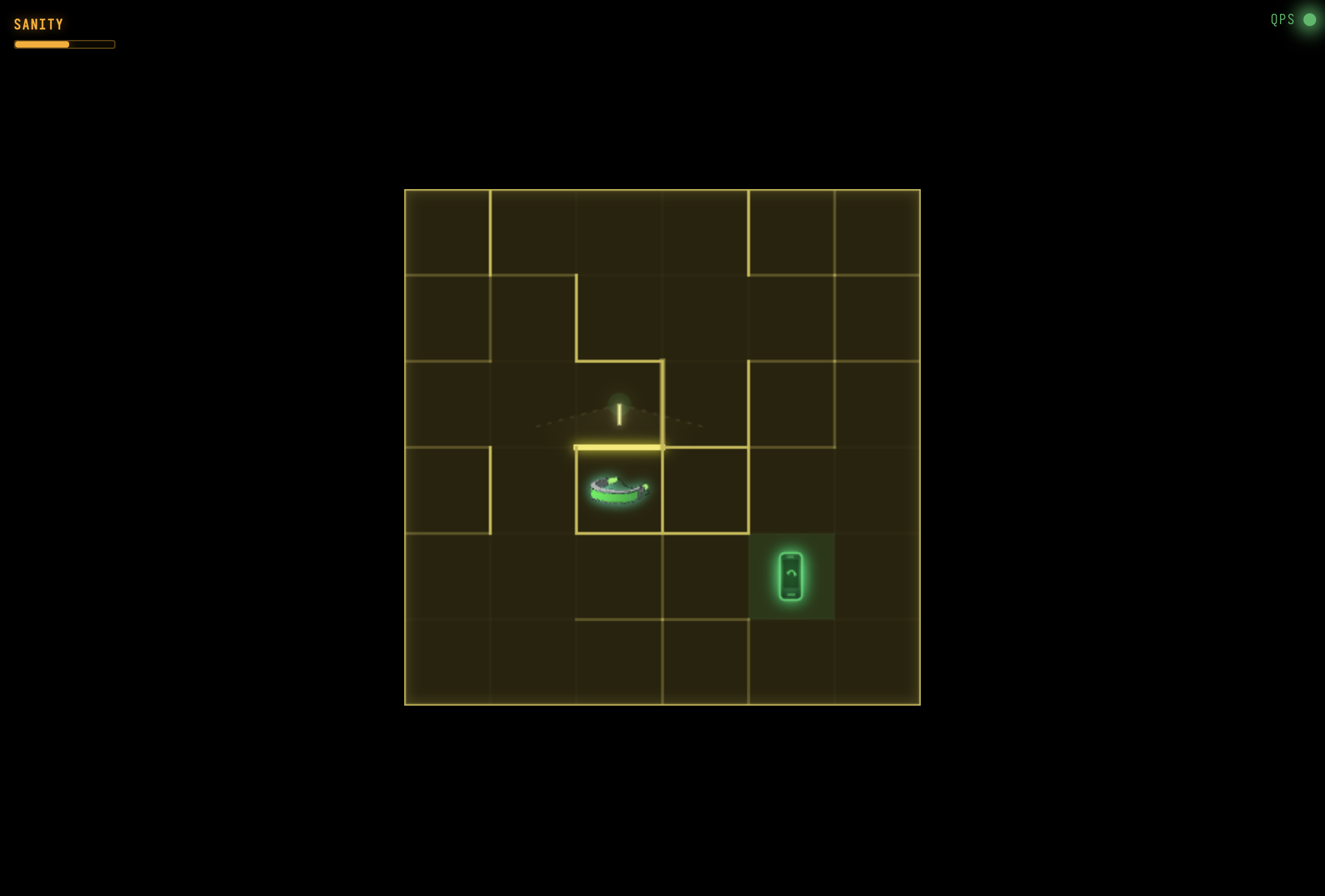
The 2D arcade mode: a top-down maze, one qubit per section.
Quantum Backrooms/Moth
A few days before launch, I got on a call with Wootton. He has worked in quantum computing for twenty years and spent part of that time at IBM, exploring what quantum computers might be able to do for games. “You’re in this strange, creepy set of rooms, you’re lost, you’re trying to find a way out,” he told me. “But when you turn around and try and go back the way you came, you find that it isn’t as you expected it to be.”
To understand what the quantum computer is doing, it helps to begin with a qubit. A classical bit records either a 0 or a 1. A qubit can be prepared in what physicists call a superposition, holding both possibilities at once, and measuring it forces one definite answer. This is slightly more than a coin toss that hasn’t been observed yet. Before measurement, the possibilities can interfere with one another, which is what separates a quantum maze from one built with a fancy dice roller. On a chip, qubits are physically connected to their neighbours, and with the right operations they develop correlations: the result from one is tied to the results from others. Those relationships are what matter for the game.
Moth generated Quantum Backrooms using processors from IBM and IQM, in some cases working with roughly a hundred qubits at a time, which Wootton says is more quantum hardware than anyone has pointed at a game before. Each section of the maze corresponds to a qubit on the chip, and the walls and openings are set by measurements of the qubits and the relationships between neighbours. “The levels are one to one related with the qubits on the device,” he said.
The maze moves because the level is never fully decided. Moth encode a well-formed maze as the lowest-energy arrangement of the qubits, the ground state of an Ising Hamiltonian, and push the processor down towards it, “but not push all the way there,” as Wootton put it, “so there’s still some jankiness and there’s still some superposition that we can sample from.” The game draws its layouts from many measured versions of that superposition; look away and back, and you may be in a different one. “You are essentially exploring a superposition of different labyrinths,” Wootton said, “and it’s only when you are looking at something that it is well defined.”
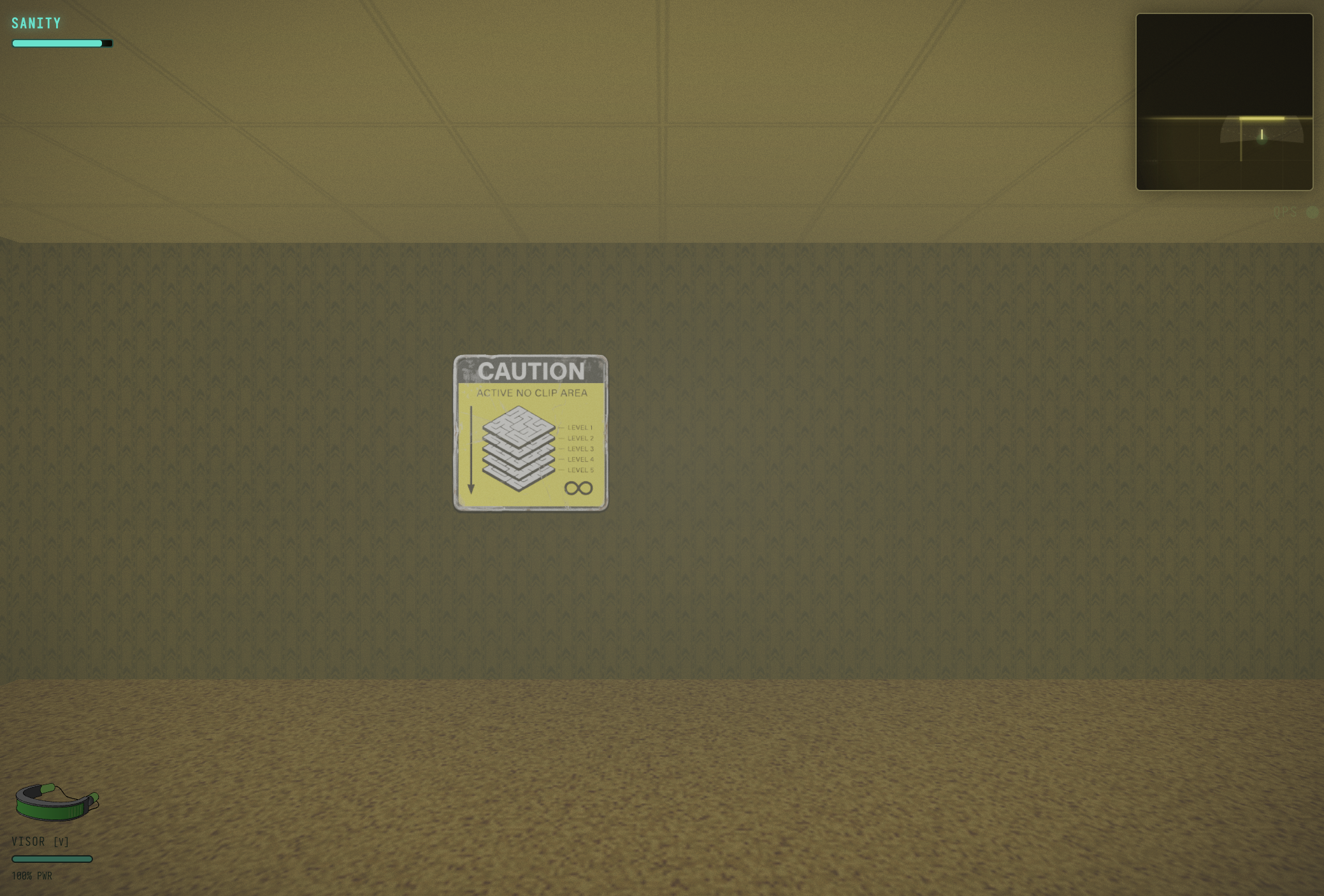
The 3D first-person mode of Quantum Backrooms, complete with sanity meter and a warning about an active no clip area.
Quantum Backrooms/Moth
The pushing is done with QuantumGraph, software Wootton began at IBM that builds circuits around the relationships you want between qubits; Moth recently published the programming model behind it.
“When I say run on a quantum computer, you don’t plug your games controller into a dilution refrigerator,” he said, having clearly met journalists before. “Classical computers are perfectly good at running computer games.” The quantum work happens in advance, and the game serves you the results: “If you’re calling a quantum computer every frame, that’s nonsense. You can’t do that.” (An earlier Moth game did generate levels live as you played, written up in a paper on quantum reservoir computing; Backrooms didn’t need it.) “It’s also worth saying that this is not a quantum advantage claim. You could use some tensor networks to get the same results. But it is nevertheless a very quantum result.” So, a classical computer could have built these mazes. It just didn’t. The levels came from real quantum hardware, and the game is designed around that hardware and its imperfections.
One of those imperfections is noise. “In some sense, the noise is the most unique thing,” Wootton told me. “Over many years I’ve discovered that noise on a real QPU is a very special and unique kind of noise that is very hard to simulate.” In this game, you can find it on foot. “If you go and find a corner of the level that just makes no sense and it’s just random nonsense, you know that those qubits are not having a good day.” Moth is using the level data to build heat maps of the chip, showing which qubits are working and which aren’t. A technical paper on the method is on its way. “It’s not a strict randomized benchmarking style benchmark,” Wootton said, “but it’s a benchmark that can give people a bit of an intuitive sense of what it is to use a quantum device.”
There’s a way to keep a score on all of this. Hundreds of games have called themselves quantum, and the games researcher Laura Piispanen, who catalogued over 260 of them, judges the claim along three dimensions: does the game feel meaningfully connected to quantum physics when you play it? Does it actually use quantum technology? And does it serve some purpose for quantum science, research or education? Wootton reckons that you can count on one hand the number of games that have really fully satisfied the dimension of running on a quantum computer. Backrooms aimed to hit all three of these dimensions.
Our interview with James Wootton, chief science officer at Moth.
At SXSW, Kumar’s presentation built to a story about John von Neumann, who was supposedly asked in the 1940s what computers would be good for, to which he answered: weather forecasting. He wasn’t wrong, computers do forecast the weather, but in that answer he missed an enormous amount of other uses. Kumar told me that von Neumann and his peers “could never have conceived of a Twitch streamer playing Grand Theft Auto Five, or an Instagram influencer, or the hyper-connected cybernetic culture of post-internet computing.”
I was curious why Moth were so intent on pointing quantumness at games. The two of them make the same argument. Quantum’s serious applications will reach the public secondhand, “not directly engaging with the consumer at the end of the experience,” as Kumar puts it; Wootton talks about “putting quantum tools in the hands of creatives” to “reach that moment where quantum is going to reach the consumer.” And “some of the earliest applications of any new technology are creative,” Kumar argues, because for a game developer or a musician a young technology’s limitations “won’t be received as blockers. If anything, those can be interesting.”
The Quantum Backrooms game went from a conference demo to a shipped game in about two months, built by a company that is, as Kumar puts it, “not a pro gaming studio.” Later this year, the company intends to open its platform more widely to musicians, artists, designers and game developers who may never have written a quantum circuit. The goal is to let them experiment with quantum-generated material. Kumar is expecting “a Cambrian revolution, an explosion of new applications.”
Our interview with Harry Kumar, co-founder of Moth.
Further reading:
Quantum Backrooms, free to play in the browser: Moth
“Defining quantum games,” Laura Piispanen and colleagues on what counts: arXiv
“Quantum circuit design via dynamic Pauli constraints,” the paper on Moth’s programming model: arXiv
“Level Generation with Quantum Reservoir Computing,” Moth’s earlier real-time generation work: arXiv
Moth’s launch announcement: The Quantum Insider
Backrooms, the film: A24