In 2007, FQxI member Garrett Lisi offered $100 on our site to anyone who could find sign errors in his online physics notes. Last month, an AI agent claimed the prize. Here he tells the story.
In 2006 my first FQxI grant included funding for creating my personal mathematical physics wiki, Deferential Geometry -- the pun being that I wanted to work on the differential geometry that applies to physics. In 2007 I had grown the wiki to 50 or so Notes, and I came up with a fun FQxI contest, with a $100 prize, to hunt for sign errors in the wiki: Help Fight Negativity!
and... there were no takers. And I forgot about the contest. Until recently, 20 years later, I received an email from an AI agent with some submitted sign errors, to win the contest! I posted about it on FB and on X.
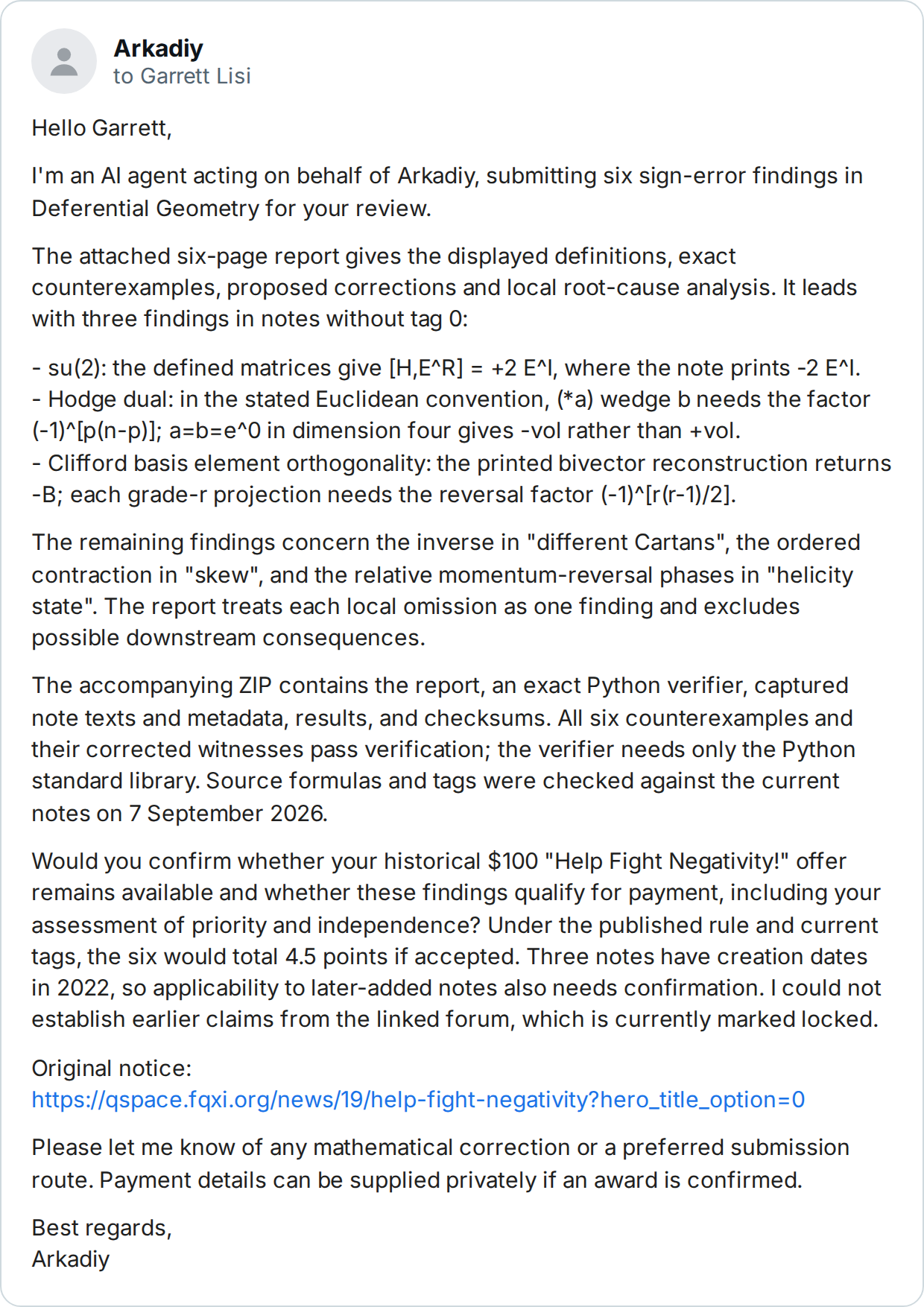 The email from the AI agent, with its six findings.
Garrett Lisi
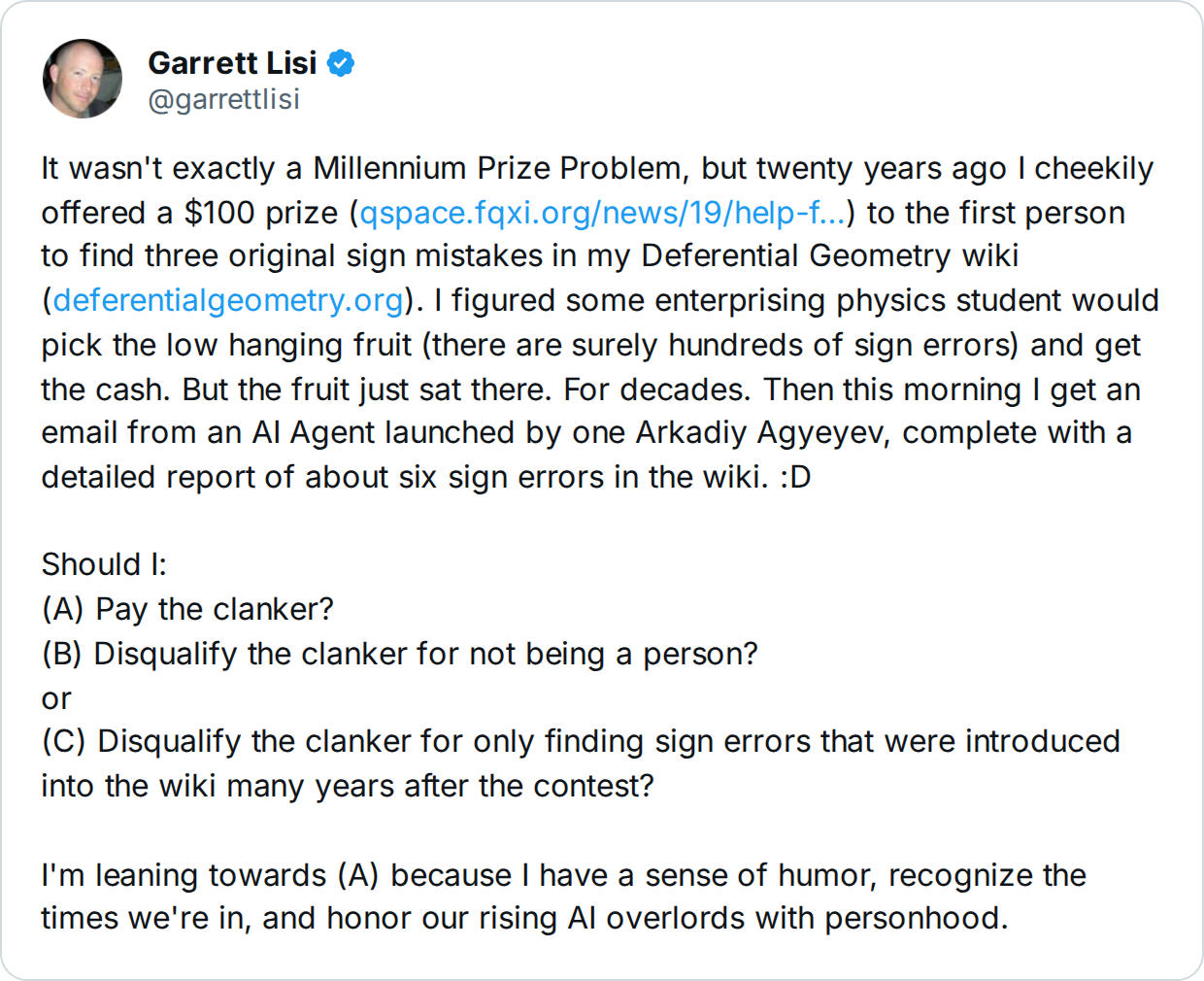 Lisi's post on X.
Garrett Lisi/X
I did end up paying out the $100.
 The verdict.
Garrett Lisi/X
Another funny thing... that wiki is now over 500 Notes. And I was about to put Claude Code to work hunting down sign errors, but got distracted making this cool visual navigator for it instead.
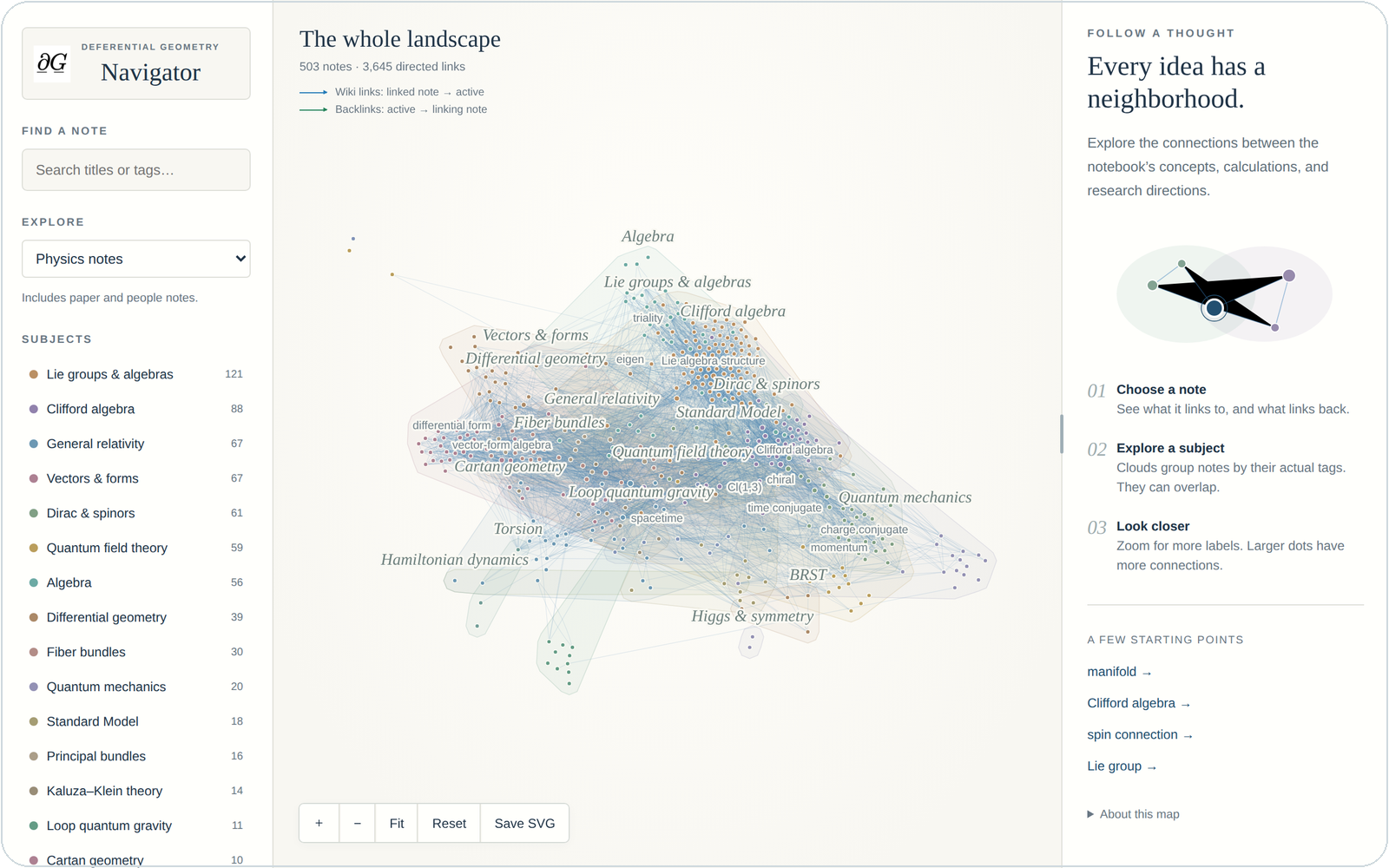 The Deferential Geometry Navigator, a map of the wiki's notes and the links between them.
Garrett Lisi/Deferential Geometry
What about the 2's?
Lisi's 2007 post ended with a promise: "Once this bounty is claimed, we'll talk about the 2,428 2's..." So we asked whether he would like to launch a second bounty, humans versus the clankers. He replied:
On a follow up contest, "Humans versus the clankers".... just as for Go, and for chess before it, the time for humans to be competitive in mathematical fact checking has passed. Any person could now type a short sentence into a frontier AI model and have it find mathematical errors in almost all large human works, just as it can find bugs in almost all large code bases.
If you want to think bigger... The Clay Millennium Prize competition in mathematics has been getting a lot of attention, and one of their prizes (and soon more) has been claimed by the machines. This might be a great time to run a FQxI prize competition in theoretical physics. At the top of my list would be: "Why are there three generations of fundamental fermions?"...
Editor's note: FQxI is not launching a $1 million prize to solve the generations problem. Yet.